

Welcome to the Modern Masters Tapestries blog! I’m so excited to launch this space and share the stories behind the incredible art we feature. For this very first article, I wanted to spotlight the iconic Joan Miró—a name that instantly conjures images of surrealist whimsy and vibrant abstraction.
While he’s widely celebrated for his paintings, sculptures, and prints, his lesser-known contributions to textile art, and especially tapestry, reveal a fascinating and often overlooked facet of his creative journey. Through Joan Miró textile art, we discover how the artist translated his vivid, dreamlike universe into the tactile world of woven masterpieces.
From Surrealism to Textile Art: Miró’s Creative Evolution
Born in Barcelona in 1893, Joan Miró’s path to becoming a full-time artist wasn’t immediate. The landscapes of his native Catalonia and the avant-garde movements of the early 20th century deeply influenced him, inspiring his unique visual language of playful, biomorphic forms, bold colors, and dreamlike spontaneity. His involvement with the Surrealist group in the 1920s further fueled his exploration of the subconscious and the poetic possibilities within art.
Miró’s venture into textile art was not a sudden shift but a natural extension of his artistic curiosity and his desire to experiment with different mediums. The tactile nature and inherent scale of tapestry weaving offered him a new and exciting surface to bring his imaginative world to life, giving his iconic imagery a new textural and monumental dimension.
L’Hirondelle Amour: A Surrealist Vision Woven in Wool
Miró’s L’Hirondelle Amour is a stunning fusion of modernist abstraction and traditional tapestry craftsmanship, perfectly illustrating his approach to textile art. Originally conceived as a painting in 1933, now part of the Museum of Modern Art’s collection in New York, this composition was later reimagined in textile form, bringing a new physicality to Miró’s signature style.
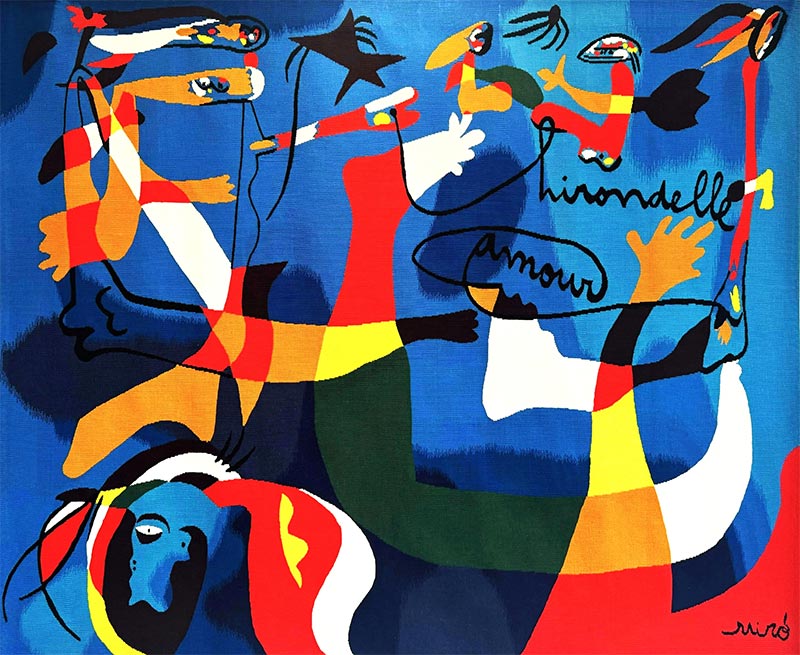
The tapestry was commissioned in 1974 by Nelson Rockefeller, who wanted to transform his treasured painting into a woven masterpiece after donating the original canvas to MoMA. Working alongside the renowned artisans of Aubusson, Miró personally supervised the translation of his fluid, dreamlike forms into a bold, tactile expression of movement and color.
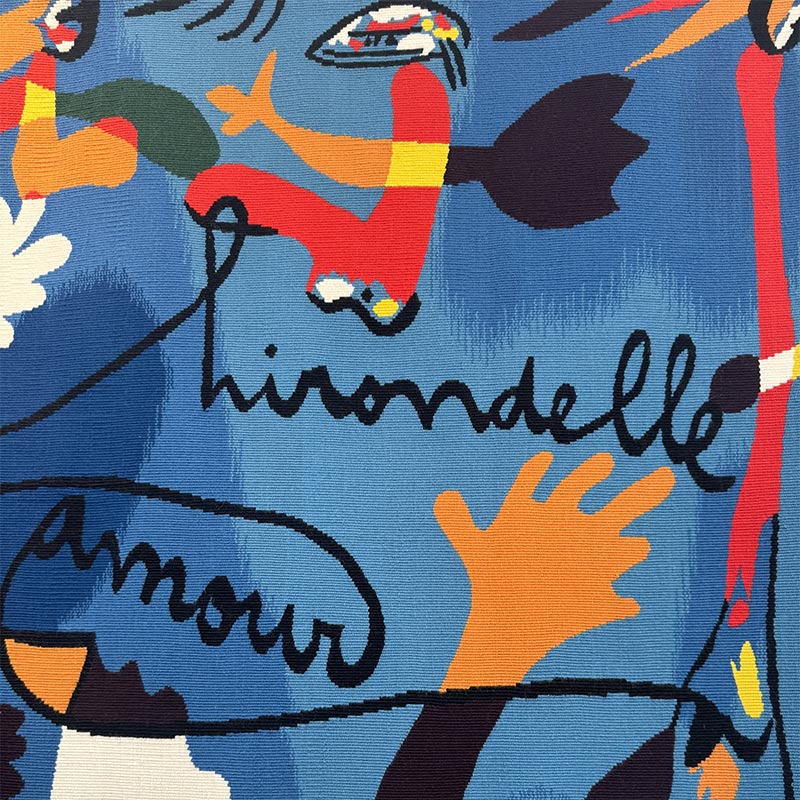
The title, Hirondelle—French for “swallow”—finds its echo in the swooping, darting shapes that evoke the energy of birds in flight. The vibrant blue background comes alive with dancing figures, fantastical creatures, and soaring birds, symbols that Miró often used to represent freedom and poetic magic. In a beautiful touch, the flowing script spelling out hirondelle amour is woven right into the scene, blending words and imagery into a unified whole.
More than just a decorative object, L’Hirondelle Amour helped shake up perceptions of textile art in the 20th century. By blurring the lines between fine art and tapestry, Miró showed that woven works could be just as expressive and impactful as painting. This wool tapestry measures approximately 63 by 79 inches (160 by 200 centimeters).
Discover our edition of L’Hirondelle Amour tapestry by Joan Miró.
Femme au miroir: A Dialogue Between Form and Reflection
The second tapestry, Femme au miroir, is equally captivating in its exploration of Joan Miró’s textile art. Here, he presents an abstracted female figure on the left, using flowing lines and playful details to suggest femininity. Opposite her, a mirror offers space for reflection, both literal and metaphorical, all set against a striking blue background framed by a bold black border.
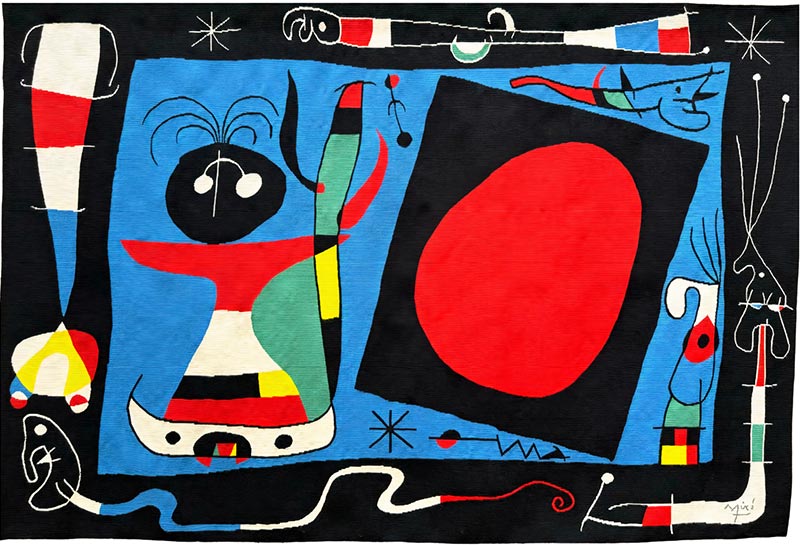
That border is particularly intriguing, filled with Miró’s signature biomorphic shapes that seem to come alive, inviting the viewer to explore their own interpretations. As always with Miró, the arrangement of lines and symbols encourages discovery and wonder, tapping into a childlike sense of imagination.
Like L’Hirondelle Amour, Femme au miroir was woven in wool based on Miró’s original design. His signature is neatly incorporated into the lower right corner, affirming the work’s authenticity and his deep involvement in its creation.
Explore our Femme au miroir tapestry, a striking example of Joan Miró textile art, available in limited edition.
Celebrating Miró’s Legacy in Textile Art
These tapestries are far from simple reproductions of existing paintings. They are the result of carefully considered collaborations between Joan Miró, ADAGP, the Mobilier National, and the esteemed Pinton Manufacture in Felletin. The Mobilier National, a prestigious French institution dedicated to preserving and promoting the nation’s decorative arts, selected Pinton to produce a limited edition of eight numbered pieces for each design. This collaboration highlights the importance and cultural value placed on these works within the world of contemporary textile art.
A testament to their enduring relevance, Joan Punyet Miró, the artist’s grandson and guardian of his legacy, has praised these tapestries as “extraordinary.” They stand as vibrant examples of how Joan Miró textile art continues to captivate and inspire, offering new ways to experience his vision in woven form. Discover more of Miró’s tapestry masterpieces in our curated collection.


