
Marc Saint-Saëns
Modern Masters Tapestries selection by Didier Marien

Learn more about the artist
Marc Saint-Saëns tapestries
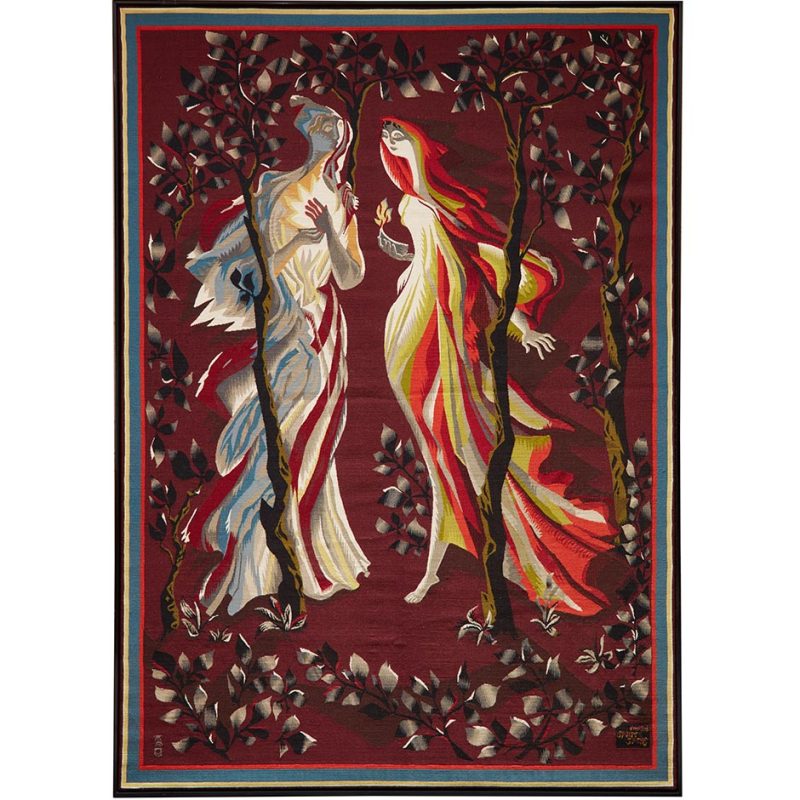
The Modern Masters Tapestries is proud to present a refined selection of tapestries inspired by the works of Marc Saint-Saëns, one of the leading figures in the revival of French tapestry in the 20th century.
A multifaceted artist—painter, printmaker, and master cartoonist for tapestry—Marc Saint-Saëns brought a lyrical, often symbolic quality to woven art. Deeply rooted in the traditions of Aubusson yet unmistakably modern in tone, Marc Saint-Saëns’ tapestries remain celebrated for their poetic imagery and subtle compositions.
Early Life and Artistic Foundations
Born Marcel Léon Saint-Saëns in 1903 in Toulouse, France, Marc Saint-Saëns came from a family of craftsmen and merchants with deep ties to the Languedoc region. He was also the great-nephew of the famous composer Camille Saint-Saëns. As a young man, he displayed a clear talent for drawing and entered the École des Beaux-Arts in Toulouse in 1920, where he studied alongside designer André Arbus. He later moved to Paris, continuing his education at the Beaux-Arts and exhibiting regularly at the Salon des artistes français.
Saint-Saëns’ early work encompassed painting and decorative arts, and in 1925 he earned a silver medal at the International Exhibition of Modern Decorative and Industrial Arts. A scholarship to the Casa de Velázquez in Madrid (1930–1933) enriched his visual language and introduced him to large-scale public commissions, including frescoes and architectural decoration.
The Turn Toward Tapestry
Though his career spanned multiple disciplines, it was in the world of tapestry that Saint-Saëns found his lasting voice. Beginning in the 1940s, under the mentorship of Jean Lurçat, he became a central figure in the renaissance of French tapestry. Together with Lurçat and others, he co-founded the Association des Peintres Cartonniers de Tapisserie (APCT) in 1947, a collective committed to revitalizing tapestry as a modern art form.
Saint-Saëns worked almost exclusively with the famed Atelier Tabard in Aubusson, which translated his painterly visions into richly woven textiles. His style favored natural motifs, symbolic forms, and a restrained color palette, often echoing the serenity of classical frescoes or the intimacy of poetic illustration.
Masterpieces and Recognition
Among his most iconic works is Le Bouquet de Lady Melanie, woven by the Atelier Picaud in Aubusson—a piece that garnered Saint-Saëns international acclaim. Other celebrated tapestries include Le Serpent de mer rose and Le Bouquet (1951), the latter being his personal favorite, according to his wife Madeleine Billot.
From 1946 to 1971, Saint-Saëns also taught drawing at the École nationale supérieure des arts décoratifs in Paris, influencing a new generation of artists, including the sculptor Pierre Manoli.
Legacy
Marc Saint-Saëns’ tapestries capture a quiet intensity and timeless beauty. While firmly embedded in the post-war movement that sought to bridge tradition and modernity, his work retains a distinct poetic sensitivity. Today, Marc Saint-Saëns tapestries continue to resonate with collectors and curators alike, offering a contemplative counterpoint to the bold abstraction of his contemporaries.
His contribution to French art is not only measured in thread and color but in his unwavering commitment to elevating tapestry as a major artistic expression of the 20th century.