
Ossip Zadkine
Modern Masters Tapestries selection by Didier Marien

Learn more about the artist
Ossip Zadkine Tapestries and Rugs
Emerging from the depths of Vitebsk, Belarus, on February 9, 1888, Ossip Zadkine’s artistry transcended borders, his Belarusian roots intertwining with the Parisian art scene. His journey began in the traditional embrace of his Jewish heritage, his artistic awakening nurtured at the Academy of Fine Arts in Vitebsk.
In 1910, Paris beckoned, and Zadkine embarked on a transformative artistic odyssey. The Académie Julian welcomed him, exposing him to the vibrant avant-garde movement, where he encountered Jean Metzinger, Albert Gleizes, and Guillaume Apollinaire.
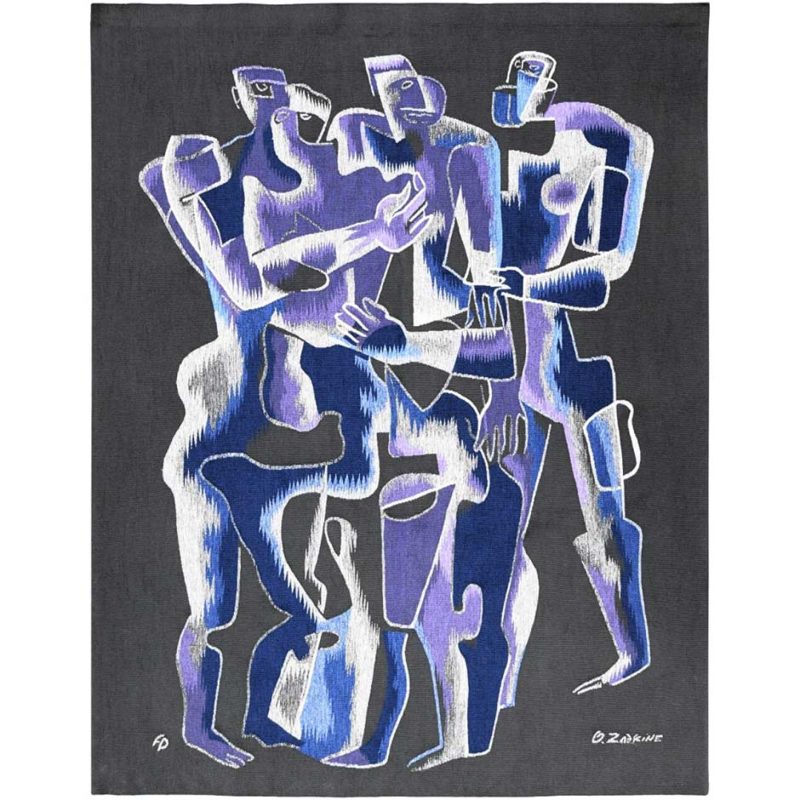
Zadkine’s spirit was captivated by the revolutionary Cubist movement, its geometric deconstruction of form resonating with his innate expressiveness. He immersed himself in this groundbreaking style, participating in the inaugural Cubist exhibition in Paris in 1911. His Cubist sculptures, exemplified by “The Cellist” (1913), stand as testaments to his mastery.
The cataclysmic World War I abruptly interrupted Zadkine’s artistic pursuits. Mobilized into the French army, he encountered the horrors of conflict, leaving an indelible mark on his psyche. Wounded in 1916, he was honorably discharged, forever bearing the war’s scars.
Despite the upheaval, Zadkine’s artistic spirit remained undimmed. He continued to sculpt, his work evolving from the angularity of Cubism towards a more expressive mode. In 1920, he unveiled his magnum opus, “The Christ of Rue Vavin,” a hauntingly poignant depiction of a crucified Christ, serving as a powerful memorial to the war’s fallen.
Zadkine’s creative flame burned brightly throughout his life, his hands shaping monumental sculptures like “The Poet” (1926), “Mother and Child” (1946), and “Reclining Woman” (1954). His legacy stands as a testament to the fusion of Cubism and Expressionism, his sculptures imbued with emotional depth and expressive power.
Ossip Zadkine, a Belarusian by birth and a Parisian by heart, left an indelible mark on the art world, his sculptures echoing with the complexities of human existence and the transformative power of art. His journey from Vitebsk to Paris, from Cubist abstraction to expressive forms, serves as a testament to the boundless creativity that transcends boundaries.