
Vassily Kandinsky
Modern Masters Tapestries selection by Didier Marien
Learn more about the artist
Vassily Kandinsky Tapestries and Rugs
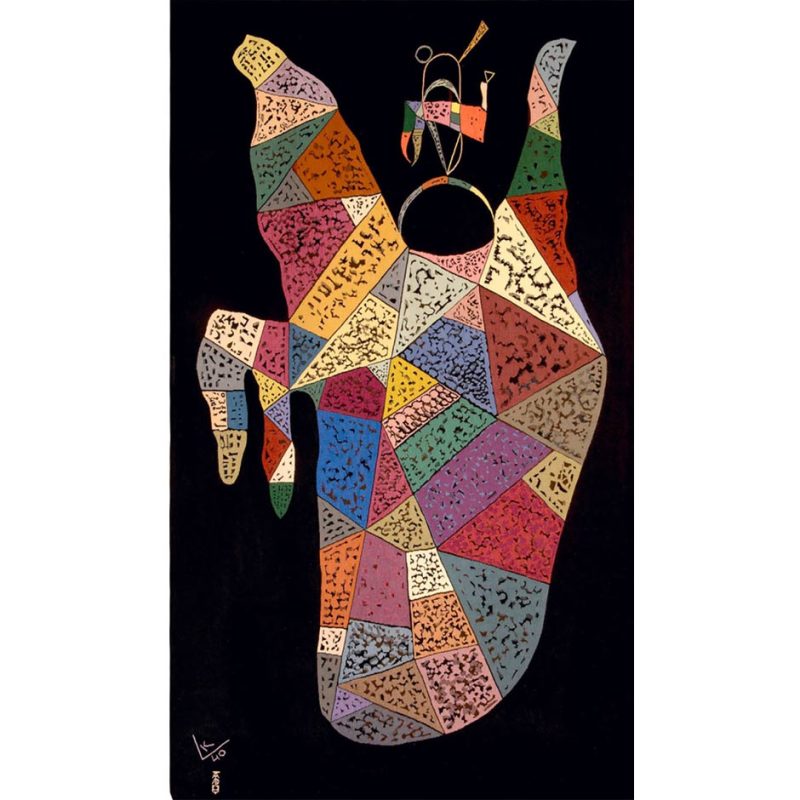
The Modern Masters Tapestries Gallery is thrilled to unveil an exceptional tapestry by Wassily Kandinsky, a masterpiece that epitomizes the artist’s groundbreaking abstract style.
Through meticulous research and collaboration with the Tabard workshop in Aubusson, Didier Marien, the gallery’s director, has secured the exclusive presentation of this remarkable piece, titled “Sur Fond Noir” (On a Black Background).
Born into an affluent and cultured family in Moscow in 1866, Wassily Kandinsky’s artistic journey was marked by a relentless pursuit of abstraction and a deep fascination with color. After studying law and economics at Moscow State University, he abandoned a promising career in academia at the age of 30 to pursue his artistic aspirations.
Kandinsky’s early paintings were influenced by Impressionist landscapes, reflecting the influence of Monet and the Parisian art scene. However, it was in Murnau, Germany, that his artistic style truly matured, as he embraced a more abstract approach, imbuing his paintings with an increasing emphasis on color and form.
In 1909, Kandinsky played a pivotal role in co-founding the Neue Künstlervereinigung München (New Artists’ Association of Munich), serving as its president until its dissolution in 1911. He subsequently established Der Blaue Reiter (The Blue Rider) in 1910, a group of like-minded artists that included August Macke, Franz Marc, Albert Bloch, and Gabriele Münter. This collective played a significant role in promoting abstract art and challenging conventional artistic norms.
The outbreak of World War I forced Kandinsky to flee Munich and seek refuge in Switzerland and later in Moscow. During his time in Russia, he actively engaged in cultural initiatives, contributing to art education, museum reforms, and the establishment of the Institute of Artistic Culture in Moscow. This period also marked the genesis of his seminal theoretical work, “Point and Line to Plane,” published in 1926.
In 1921, seeking a more stable environment, Kandinsky accepted a teaching position at the Bauhaus, a renowned art and design school in Germany. He remained a faculty member until its closure by the Nazi regime in 1933, at which point he was stripped of his German citizenship and forced to seek refuge in France.
Settling in Neuilly-sur-Seine, France, Kandinsky continued his artistic explorations, undeterred by the challenges of exile and the looming threat of war. He embraced French citizenship in 1939, shortly before the outbreak of World War II. Throughout his final years, he continued to create groundbreaking works, further cementing his legacy as a pioneer of abstract art.
The tapestry “Sur Fond Noir” is a testament to Kandinsky’s mastery of color and composition. The intricate interplay of vibrant hues and abstract forms exudes a sense of dynamism and energy, capturing the essence of the artist’s revolutionary approach to art.
The Modern Masters Tapestries Gallery’s exclusive presentation of this remarkable tapestry offers a rare opportunity to experience the transformative power of Kandinsky’s art in a unique and immersive setting.