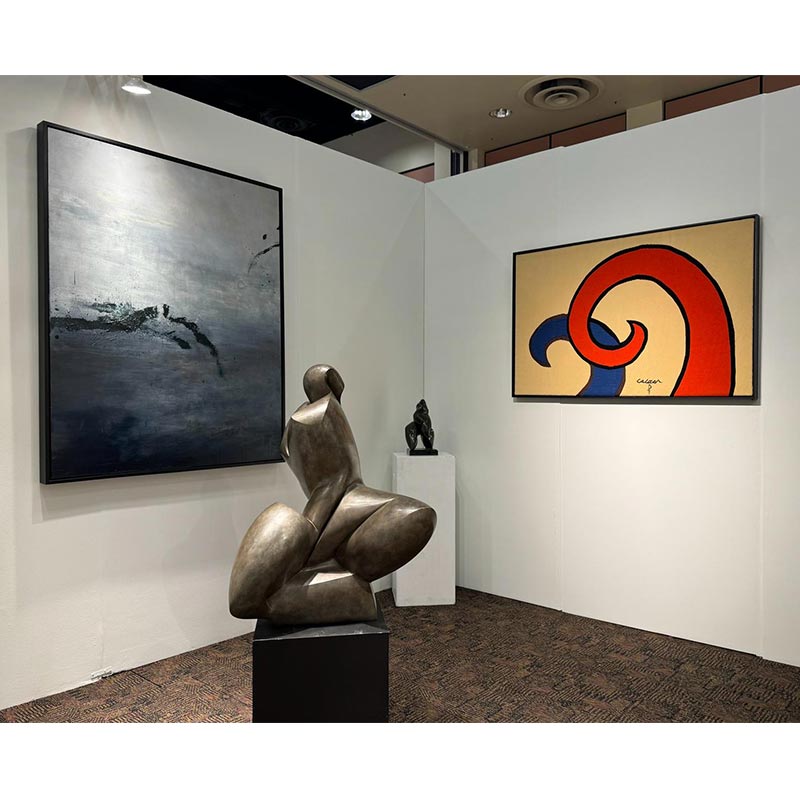

Waves
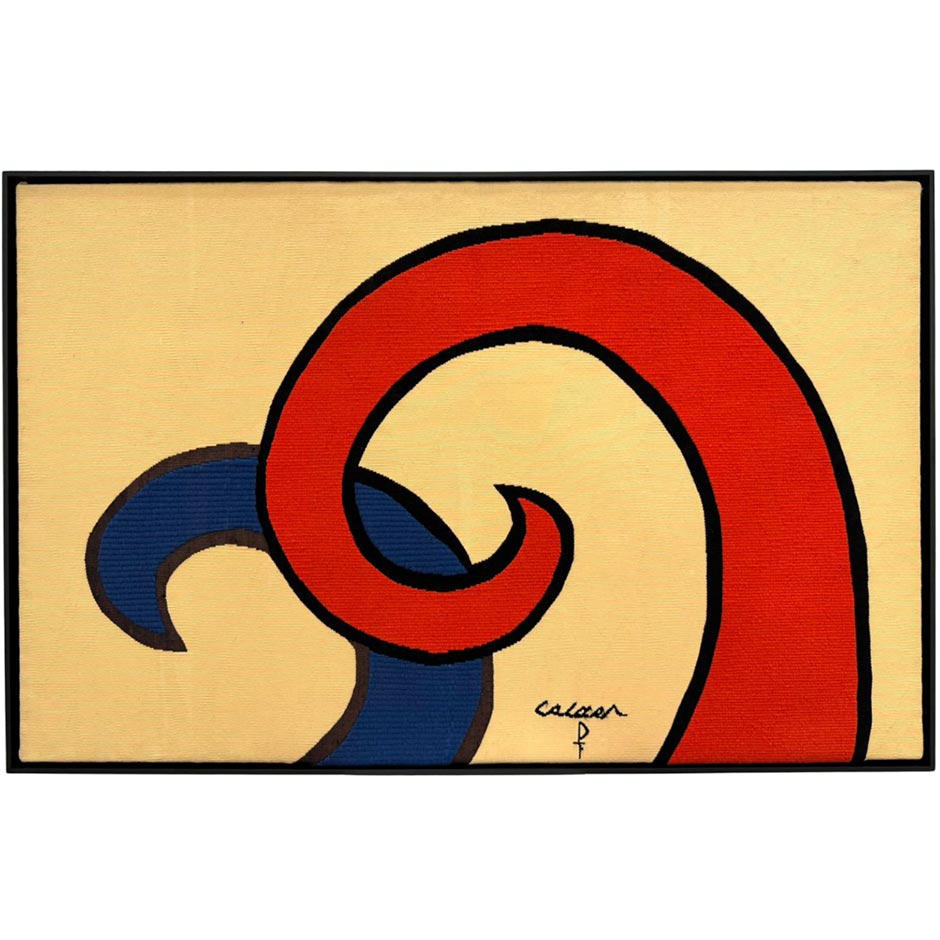
Dimensions: 59 x 41 in. (150 x 103 cm)
Material: Handwoven wool and silk tapestry by Atelier Pinton, Aubusson, France
Artist signature: Signed by artist and monogrammed by atelier
Serial: Edition/50. Approximately fifty tapestries were produced out of an initial production of one hundred and fifty
Date: 1975
Detailed information
Alexander Calder “Waves” Tapestry
Alexander Calder’s innovative approach to art shines in his “Waves” tapestry. This hand-woven artwork, created at the renowned Aubusson studios in France, translates his signature ability to capture movement into a three-dimensional “drawing” in space.
Part of a limited series of six commemorating the 200th anniversary of the American Revolution, only a small number (approximately 37) from the original edition of 200 were ever produced. The “Waves” tapestries were meticulously woven by Pinton Freres, further solidifying the exceptional quality and historical significance of this work.
Alexander Calder’s artistic identity blossomed at the intersection of movement, abstraction, and a playful spirit. Renowned for his mobiles, suspended sculptures that danced in air currents, Calder brought a sense of kineticism to the art world. This interplay of balance and chance became a defining feature of his work.
While his early pieces dabbled with figurative elements, Calder primarily embraced abstraction. He wielded geometric shapes, vibrant colors, and biomorphic curves – organic shapes inspired by nature – to forge a unique visual language. This connection to the natural world, evident in recurring motifs like leaves and insects, injects a touch of whimsy and playfulness into his art.
Calder’s background in mechanical engineering and childhood fascination with the circus profoundly influenced his artistic approach. He incorporated elements of balance, movement, and mechanical ingenuity into his sculptures, often employing simple materials like sheet metal and wire. This fusion of artistic expression and engineering principles further cemented his legacy as a pioneer of kinetic art.
Detailed information
Alexander Calder “Waves” Tapestry
Alexander Calder’s innovative approach to art shines in his “Waves” tapestry. This hand-woven artwork, created at the renowned Aubusson studios in France, translates his signature ability to capture movement into a three-dimensional “drawing” in space.
Part of a limited series of six commemorating the 200th anniversary of the American Revolution, only a small number (approximately 37) from the original edition of 200 were ever produced. The “Waves” tapestries were meticulously woven by Pinton Freres, further solidifying the exceptional quality and historical significance of this work.
Alexander Calder’s artistic identity blossomed at the intersection of movement, abstraction, and a playful spirit. Renowned for his mobiles, suspended sculptures that danced in air currents, Calder brought a sense of kineticism to the art world. This interplay of balance and chance became a defining feature of his work.
While his early pieces dabbled with figurative elements, Calder primarily embraced abstraction. He wielded geometric shapes, vibrant colors, and biomorphic curves – organic shapes inspired by nature – to forge a unique visual language. This connection to the natural world, evident in recurring motifs like leaves and insects, injects a touch of whimsy and playfulness into his art.
Calder’s background in mechanical engineering and childhood fascination with the circus profoundly influenced his artistic approach. He incorporated elements of balance, movement, and mechanical ingenuity into his sculptures, often employing simple materials like sheet metal and wire. This fusion of artistic expression and engineering principles further cemented his legacy as a pioneer of kinetic art.