

Flowers
Dimensions: 72 x 72 in (184 x 184 cm)
Material: Handwoven wool tapestry by Atelier Modern Masters Tapestry, New York
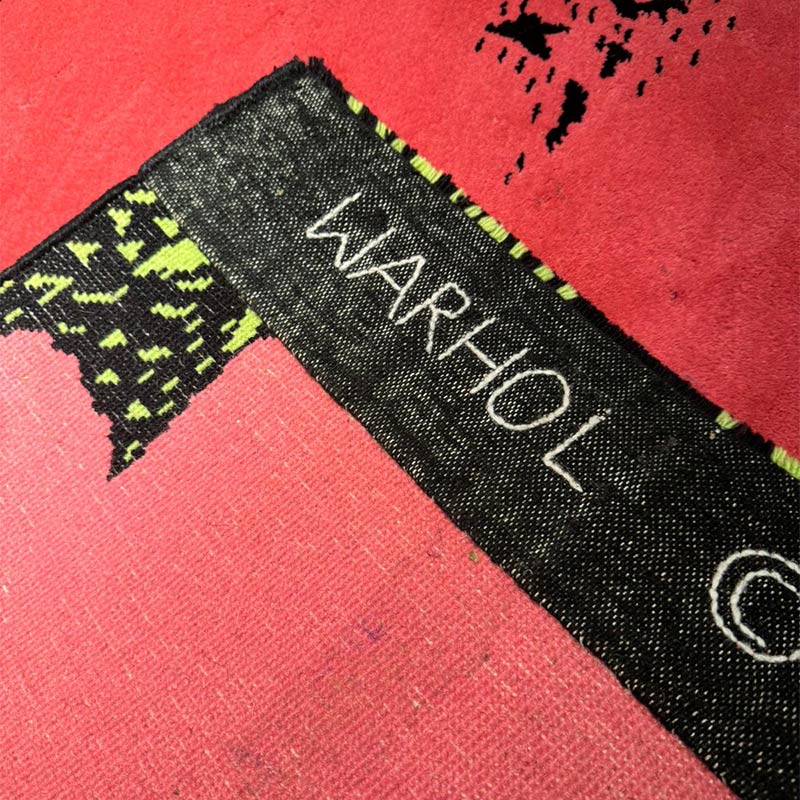
Artist signature: Signature woven on the lower right, and signed Warhol with copyright on the back
Date: After a work from 1964, produced in 1980
Edition: Edition of 20
Detailed information
Andy Warhol “Flowers” Tapestry
Modern Masters Tapestrie Gallery is proud to present Andy Warhol’s Flowers, a stunning tapestry that captures the spirit of her artistic innovation and serves as a lasting tribute to her influential career.
Throughout art history, the flower and its symbolism have been a subject matter for many renowned artists. Andy Warhol explored the qualities of the flower image through his Pop Art prism in the Flower series of 1964, thus creating cartoon-like symbols that would be instantly recognized.
The 1964 Flower series became one of his most iconic and successful works. Based on a discovered photograph of hibiscus blossoms, Warhol drenched the flowers’ floppy shapes with a variation of vibrant colors, transforming them into psychedelic indoor décor. Playing with traditional art historical themes, Andy Warhol gave a particular twist to this historically accepted symbol of life. The electric colors of his flowers, drawn from a darker and rich undergrowth background might be the indicator of an extreme vision of life, a life lived on the edge.
Detailed information
Andy Warhol “Flowers” Tapestry
Modern Masters Tapestrie Gallery is proud to present Andy Warhol’s Flowers, a stunning tapestry that captures the spirit of her artistic innovation and serves as a lasting tribute to her influential career.
Throughout art history, the flower and its symbolism have been a subject matter for many renowned artists. Andy Warhol explored the qualities of the flower image through his Pop Art prism in the Flower series of 1964, thus creating cartoon-like symbols that would be instantly recognized.
The 1964 Flower series became one of his most iconic and successful works. Based on a discovered photograph of hibiscus blossoms, Warhol drenched the flowers’ floppy shapes with a variation of vibrant colors, transforming them into psychedelic indoor décor. Playing with traditional art historical themes, Andy Warhol gave a particular twist to this historically accepted symbol of life. The electric colors of his flowers, drawn from a darker and rich undergrowth background might be the indicator of an extreme vision of life, a life lived on the edge.