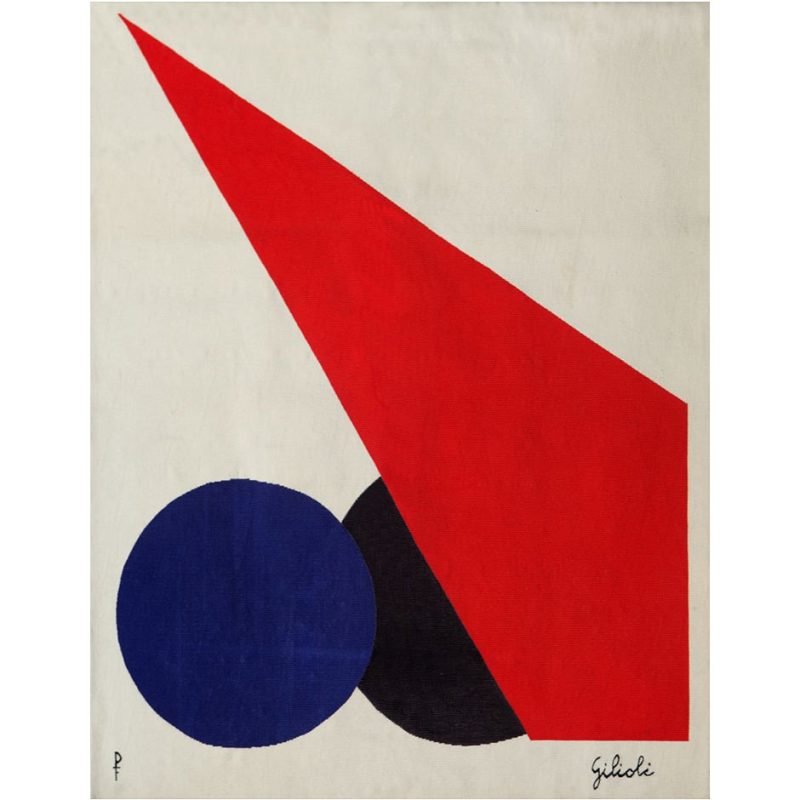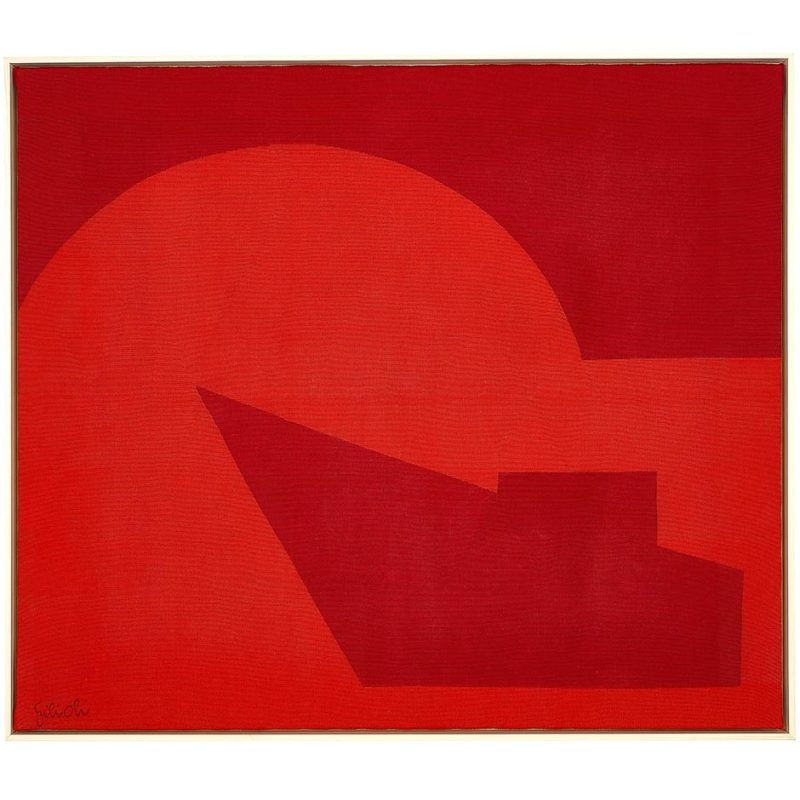

Fenêtre
Dimensions: 57 x 81 in. (145 x 205 cm)
Material: Wool tapestry woven in Aubusson.
Artist signature: Gilioli
Date: Circa 1970
Serial: 2/3
Detailed information
Emile Gilioli “Fenêtre” Tapestry
The “Fenêtre” (Window) tapestry, created by the renowned French artist Emile Gilioli, is a mesmerizing embodiment of Gilioli’s profound artistic vision and the tapestry weaving tradition’s enduring craftsmanship.
Emerging from a family of Italian shoemakers in Paris, Emile Gilioli emerged as a pivotal figure in post-war abstract sculpture. His childhood was spent in Italy, where he immersed himself in the art of blacksmithing, a skill that would later inform his sculptural practice. Upon joining his father in Nice, Gilioli embarked on a formal training in sculpture. In 1931, he pursued his artistic aspirations further by enrolling at the prestigious Ecole Nationale des Beaux-Arts in Paris.
The outbreak of World War II led to Gilioli’s mobilization, and he found himself in Grenoble. During this period, he encountered a diverse range of artistic influences that profoundly impacted his creative direction, prompting him to break free from the constraints of academicism and embrace a more simplified approach to form. This pivotal shift in his artistic expression was further solidified upon his return to Paris in 1945.
Gilioli’s artistic journey continued to evolve, leading him towards the realm of non-figurative art. He found himself aligned with fellow artists such as Vasarely, Brancusi, Deyrolle, and Poliakoff, a group that collectively explored the boundaries of abstract expression. Actively engaged in the vibrant Parisian art scene, Gilioli participated in numerous exhibitions at renowned galleries, including Denise René, Louis Carré, and Dina Vierny. His work also graced the walls of prestigious salons such as the Salon des Réalités Nouvelles and the Salon de Mai.
Gilioli’s contributions to the art world extended beyond his sculptures. He played a founding role in the Salon de la Jeune Sculpture and served as vice-president of the Espace group alongside luminaries like André Bloc, Fernand Léger, and Le Corbusier. These associations further cemented his position as a leading figure in the post-war art world.
Detailed information
Emile Gilioli “Fenêtre” Tapestry
The “Fenêtre” (Window) tapestry, created by the renowned French artist Emile Gilioli, is a mesmerizing embodiment of Gilioli’s profound artistic vision and the tapestry weaving tradition’s enduring craftsmanship.
Emerging from a family of Italian shoemakers in Paris, Emile Gilioli emerged as a pivotal figure in post-war abstract sculpture. His childhood was spent in Italy, where he immersed himself in the art of blacksmithing, a skill that would later inform his sculptural practice. Upon joining his father in Nice, Gilioli embarked on a formal training in sculpture. In 1931, he pursued his artistic aspirations further by enrolling at the prestigious Ecole Nationale des Beaux-Arts in Paris.
The outbreak of World War II led to Gilioli’s mobilization, and he found himself in Grenoble. During this period, he encountered a diverse range of artistic influences that profoundly impacted his creative direction, prompting him to break free from the constraints of academicism and embrace a more simplified approach to form. This pivotal shift in his artistic expression was further solidified upon his return to Paris in 1945.
Gilioli’s artistic journey continued to evolve, leading him towards the realm of non-figurative art. He found himself aligned with fellow artists such as Vasarely, Brancusi, Deyrolle, and Poliakoff, a group that collectively explored the boundaries of abstract expression. Actively engaged in the vibrant Parisian art scene, Gilioli participated in numerous exhibitions at renowned galleries, including Denise René, Louis Carré, and Dina Vierny. His work also graced the walls of prestigious salons such as the Salon des Réalités Nouvelles and the Salon de Mai.
Gilioli’s contributions to the art world extended beyond his sculptures. He played a founding role in the Salon de la Jeune Sculpture and served as vice-president of the Espace group alongside luminaries like André Bloc, Fernand Léger, and Le Corbusier. These associations further cemented his position as a leading figure in the post-war art world.