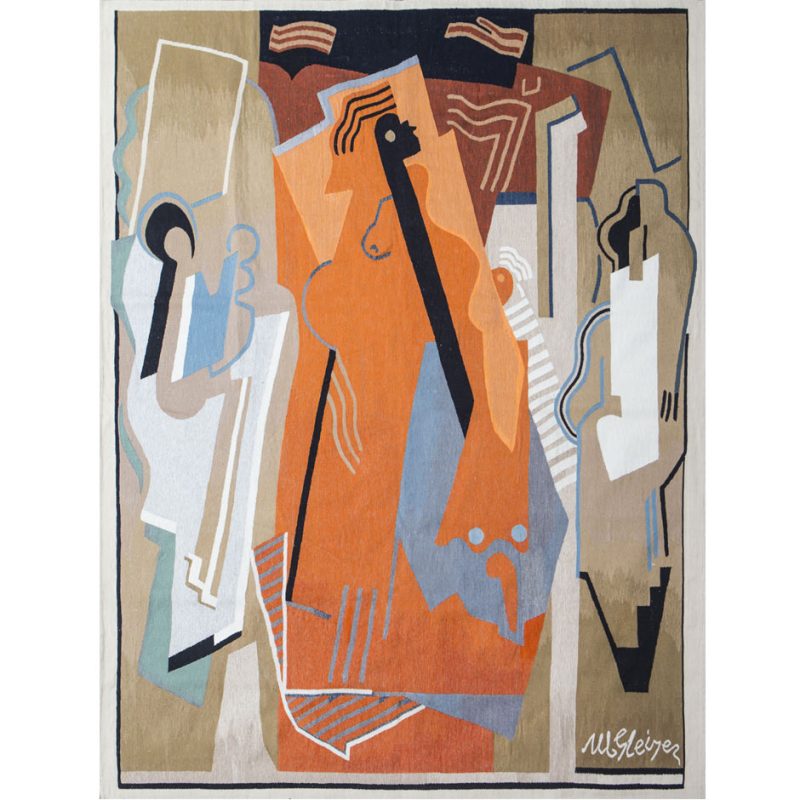
Les Trois Musiciens
Material: Handwoven wool tapestry from Cauquil-Prince workshop in Paris
Dimensions : 250 x 270 cm – 98 x 106 in.
Date: circa 1980
Detailed information
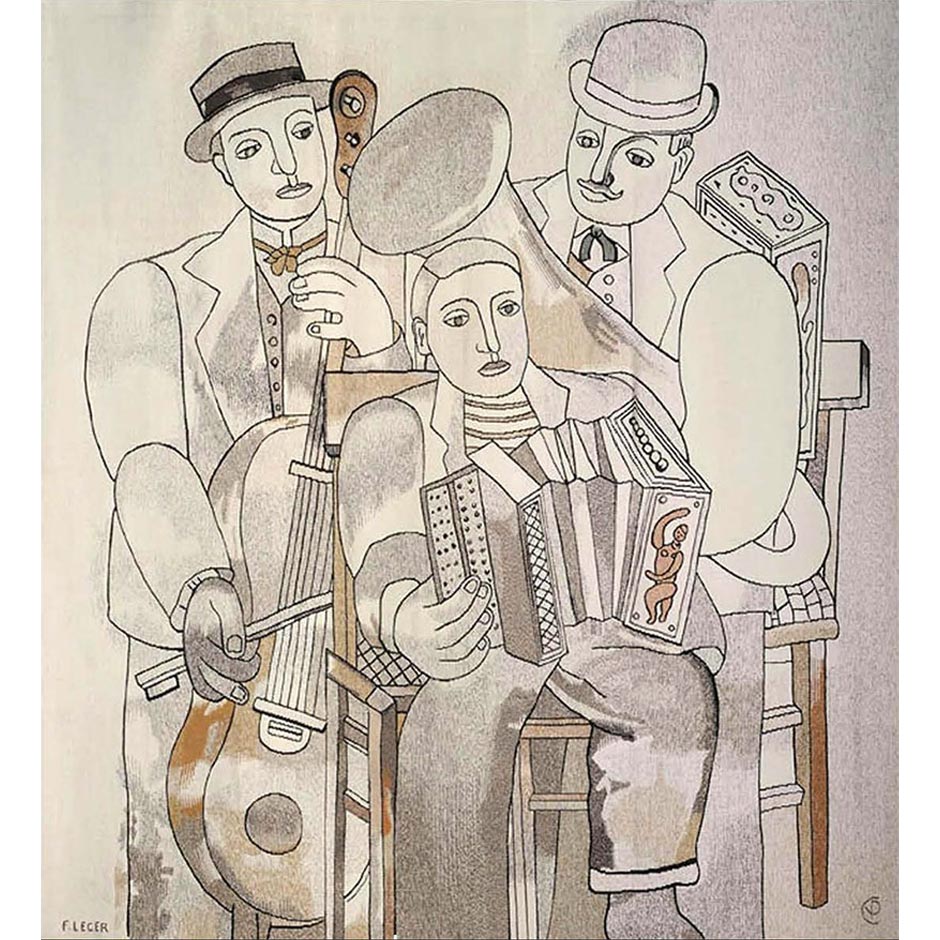
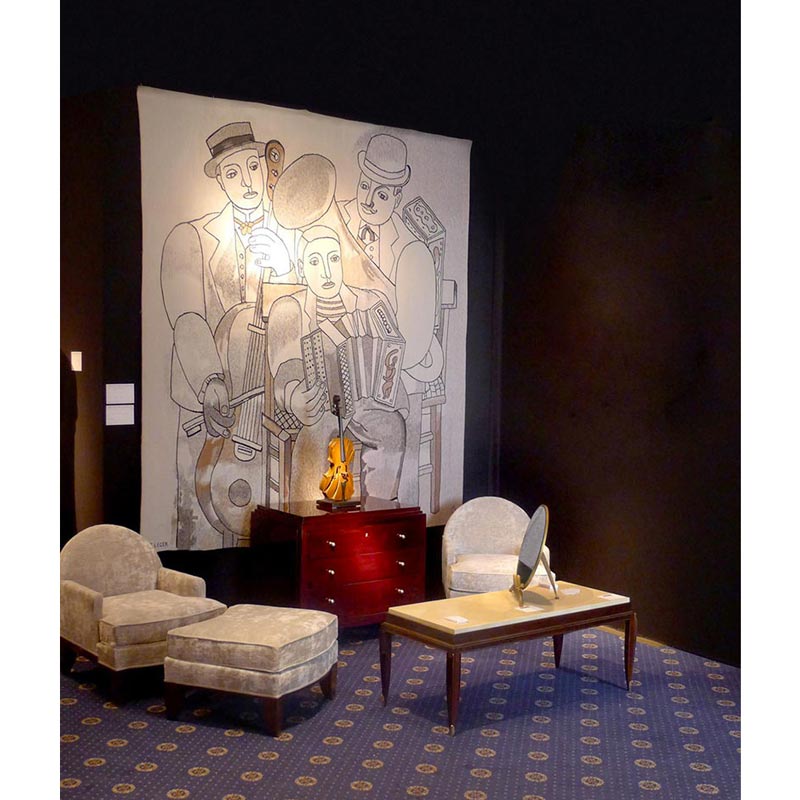
Fernand Léger “Les Trois Musiciens” Tapestry
Fernand Léger “Les Trois Musiciens” (The Three Musicians) tapestry is a stunning piece. The history of the original painting is surprising.
Fernand Leger, an enthusiastic fan of popular entertainment, frequented the bals musettes in the rue de Lappe in Paris, where small orchestras played accordion, tuba, and double bass to the delight of the dancing crowd. This large canvas was probably painted by Leger to decorate the stage of a bal. When the project was abandoned, the canvas was bleached by Leger and rolled up, forgotten in his studio.
Georges Bauquier, a close collaborator of Leger, recounts that while tidying up the studio, he discovered the rolled-up canvas, revealing traces of a drawing and colors in its folds. Bauquier had the bleached surface of the canvas removed and showed the finished work to Leger, who gave it to him as a token of his appreciation.
The work is preserved in its original state, with the wear and tear of the scraping and the lack of colors. It retains a faded appearance, but it highlights the artist’s masterful linework. The theme of the three musicians, with their placid faces and Sunday best, returns in a canvas painted in the United States in 1944 and then more often to accompany acrobats and dancers in the series of the Cirque.
Detailed information
Fernand Léger “Les Trois Musiciens” Tapestry
Fernand Léger “Les Trois Musiciens” (The Three Musicians) tapestry is a stunning piece. The history of the original painting is surprising.
Fernand Leger, an enthusiastic fan of popular entertainment, frequented the bals musettes in the rue de Lappe in Paris, where small orchestras played accordion, tuba, and double bass to the delight of the dancing crowd. This large canvas was probably painted by Leger to decorate the stage of a bal. When the project was abandoned, the canvas was bleached by Leger and rolled up, forgotten in his studio.
Georges Bauquier, a close collaborator of Leger, recounts that while tidying up the studio, he discovered the rolled-up canvas, revealing traces of a drawing and colors in its folds. Bauquier had the bleached surface of the canvas removed and showed the finished work to Leger, who gave it to him as a token of his appreciation.
The work is preserved in its original state, with the wear and tear of the scraping and the lack of colors. It retains a faded appearance, but it highlights the artist’s masterful linework. The theme of the three musicians, with their placid faces and Sunday best, returns in a canvas painted in the United States in 1944 and then more often to accompany acrobats and dancers in the series of the Cirque.