

La licorne
Dimensions: 56 x 77 in. (142 x 195 cm)
Material: Handwoven wool tapestry by Atelier Picaud, Aubusson
Artist signature: Signed and monogrammed by the workshop
Date: Circa 1960
Serial: Edition 1/6
Detailed information
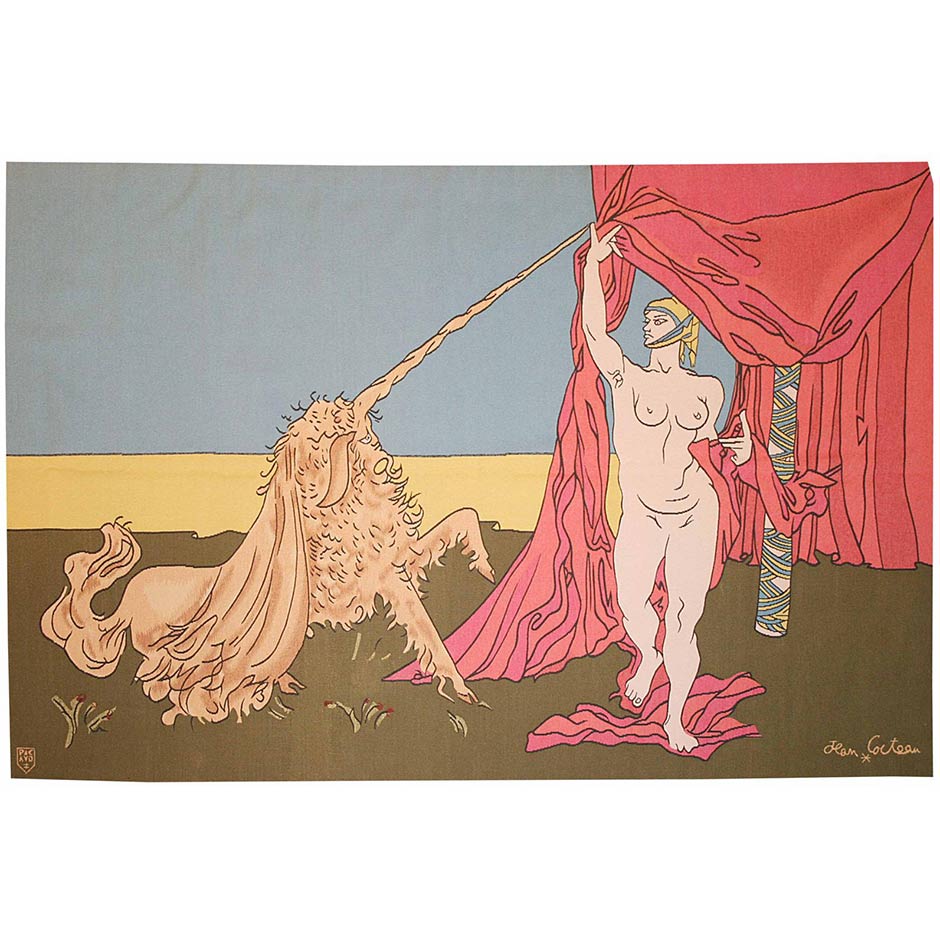
Jean Cocteau “La licorne” Tapestry
The “La licorne” tapestry is a stunning expression of Jean Cocteau’s captivating vision. Woven by the renowned Picaud atelier, it exemplifies the enduring impact of both the artist and the centuries-old tradition of French tapestry weaving.
Jean Cocteau was a true artistic titan of the 20th century. A polymath in the truest sense, his creative endeavors spanned poetry, theater, filmmaking, drawing, and printmaking, leaving an indelible mark on each.
Cocteau was a central figure in the Parisian avant-garde scene during its early years, finding himself at home among the Surrealists and Dadaists. While his writing and films may be his most recognized works, his dedication to drawing and printmaking resulted in a unique style characterized by elegant, whimsical lines. This visual artistry is now proudly displayed in prestigious collections around the world, including the Museum of Modern Art in New York, the Courtauld Institute of Art in London, and the National Gallery of Art in Washington, D.C.
Cocteau’s influence extended far beyond any one medium. The National Observer aptly described him as “the closest thing to a Renaissance man” among the artistic generation that dared to define 20th century art.
Detailed information
Jean Cocteau “La licorne” Tapestry
The “La licorne” tapestry is a stunning expression of Jean Cocteau’s captivating vision. Woven by the renowned Picaud atelier, it exemplifies the enduring impact of both the artist and the centuries-old tradition of French tapestry weaving.
Jean Cocteau was a true artistic titan of the 20th century. A polymath in the truest sense, his creative endeavors spanned poetry, theater, filmmaking, drawing, and printmaking, leaving an indelible mark on each.
Cocteau was a central figure in the Parisian avant-garde scene during its early years, finding himself at home among the Surrealists and Dadaists. While his writing and films may be his most recognized works, his dedication to drawing and printmaking resulted in a unique style characterized by elegant, whimsical lines. This visual artistry is now proudly displayed in prestigious collections around the world, including the Museum of Modern Art in New York, the Courtauld Institute of Art in London, and the National Gallery of Art in Washington, D.C.
Cocteau’s influence extended far beyond any one medium. The National Observer aptly described him as “the closest thing to a Renaissance man” among the artistic generation that dared to define 20th century art.