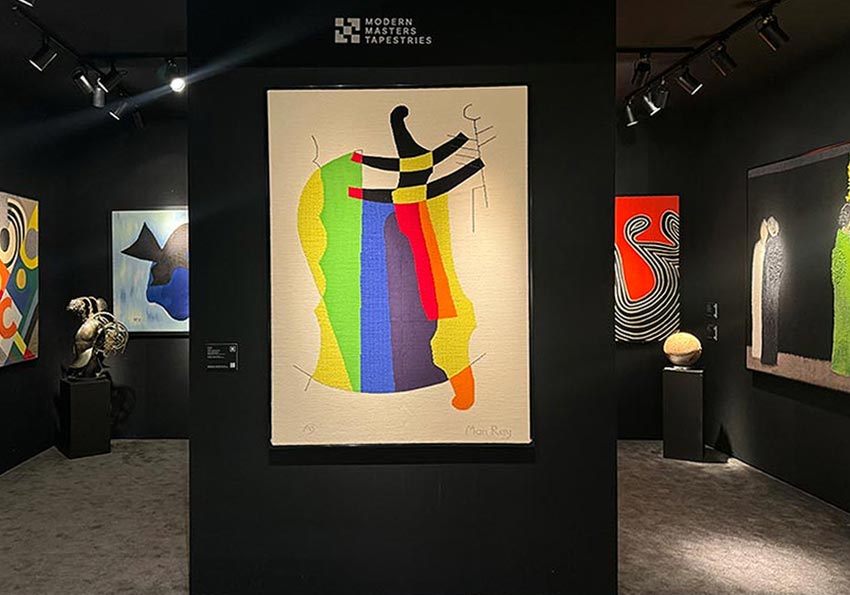

Welcome back to the Modern Masters Tapestries blog! I’m so excited to dive into the stories behind the art we cherish, and today, we’re shining a spotlight on a figure whose vision was as transformative as the artists she collaborated with: the master weaver Yvette Cauquil-Prince.
While we often celebrate the painters and sculptors who conceived these iconic works, the genius of a master weaver like Yvette Cauquil-Prince (1928–2005) is what truly brought them to life in thread. A Belgian-born artist, she devoted her career to translating the visions of the 20th century’s greatest masters into stunning, monumental tapestries, a process that was not mere reproduction but an act of brilliant interpretation.
She became a central figure in the 20th-century tapestry revival, dedicating her career to creating tapestries in direct collaboration with some of the era’s most renowned artists and their estates. Her work was not a simple reproduction but a creative interpretation, with one source describing her as a “Maître d’œuvre” or master builder. She was highly skilled at transcribing works from different mediums—such as paintings, drawings, and lithographs—into the woven form, capturing the expressive richness of the original art while also offering a new reading of the work.
A Visionary Collaborator
Cauquil-Prince’s journey began with a mastery of her craft that was largely self-taught, inspired by her study of ancient Coptic textiles and tapestries from the Middle Ages and Renaissance. She established her first studio in Paris in the late 1950s, quickly earning a reputation for her exceptional skill. She was eventually awarded the Chevalier of the Ordre national du Mérite by the French government in 1977, a testament to her profound impact.
Her approach was unique; she wasn’t simply a technician but a true artistic partner. She developed a complex shorthand code that allowed her to create intricate “cartoons” or blueprints for her weavers, making her the “Maître d’œuvre” (master builder) of each piece. This dedication to a new form of artistic expression led to collaborations with a constellation of modern art titans, including Pablo Picasso, Max Ernst, and Paul Klee.
The Toscanini of Tapestry
Cauquil-Prince’s most profound and enduring collaboration was with Marc Chagall. They began working together in the mid-1960s, a partnership that would last until Chagall’s death in 1985. Their relationship was so close and creatively fruitful that Chagall called her “the Toscanini of tapestry,” referring to the famous conductor, and declared, “There will never be a tapestry by Chagall without you”. He even referred to her as his “spiritual daughter”. After his passing, she remained close to his family and, with their blessing, continued to translate his work into tapestries, fulfilling a promise she had made to the artist.
Legacy Woven in Thread
Like the Miró and Calder tapestries we have celebrated, Cauquil-Prince’s work helped to blur the lines between “fine art” and decorative art, proving that tapestries could be just as expressive and important as paintings. She worked with Alexander Calder to translate his kinetic, whimsical designs into the textile medium, helping him extend his legacy beyond his famous mobiles. One notable example is the handwoven wool tapestry, Les Balloons, created in 1969. Her ability to capture the dynamic motion and playful spirit of Calder’s work in a new format truly highlights her versatile genius.
Yvette Cauquil-Prince’s life and work perfectly embody the spirit of Modern Masters Tapestries. She was an innovator who consistently redefined art and design by pushing the boundaries of what a tapestry could be. Her legacy is a testament to the power of collaboration and the enduring beauty that can be achieved when an artist’s vision is brought to life through a master weaver’s hands. It’s a privilege to share her story and to continue showcasing her impact on the world of modern art.