VP KEK
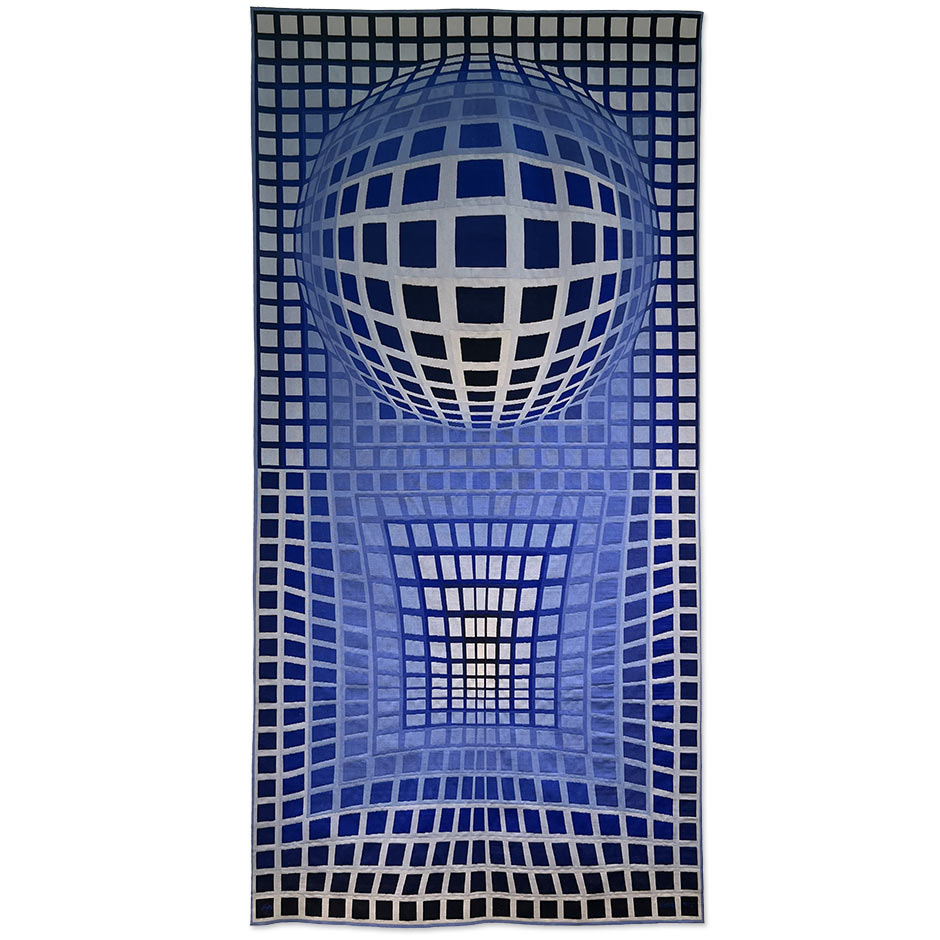
Material: wool Aubusson tapestry woven at Pinton workshop
Dimensions : 292 x 145 cm – 114 x 57 in.
Date: 1971
Detailed information
Victor Vasarely “VP KEK” Tapestry
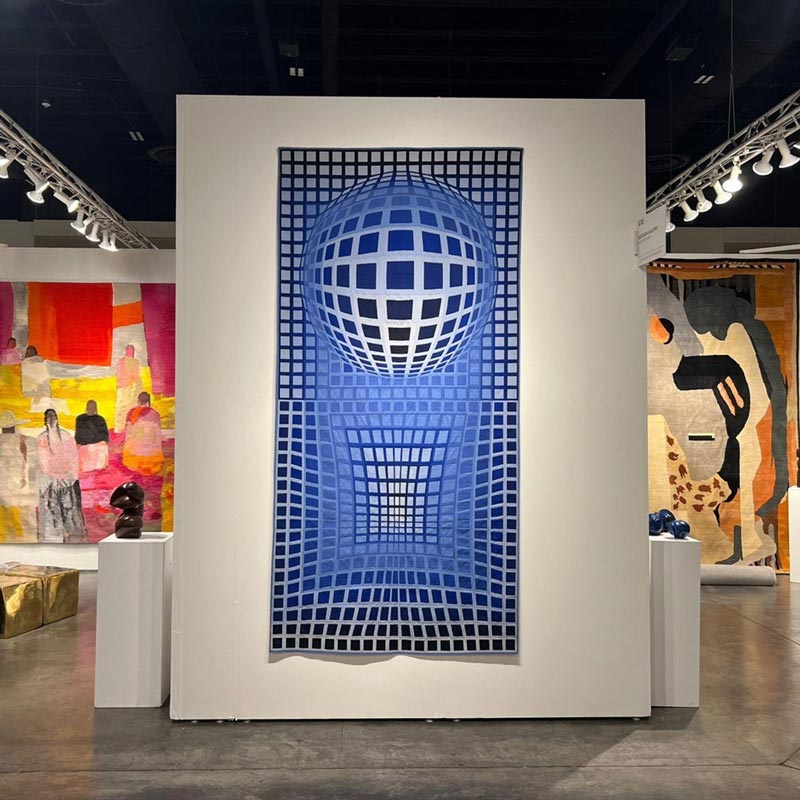
“VP KEK” a towering tapestry created by Vasarely in 1971, stands as a testament to his mastery of geometric abstraction and optical illusion. Its bold, blue and green squares and circles, spanning over nine feet in height and sixteen feet in width, create a mesmerizing visual play that captivates viewers from a distance. The illusion of three-dimensionality, with shapes seemingly popping out and receding, lures the audience into closer inspection.
As one approaches the tapestry, the illusion dissolves, revealing the flat, two-dimensional reality of the geometric forms. This interplay of illusion and reality is a hallmark of Vasarely’s work, making his art both intriguing and intellectually stimulating.
Beyond “VP KEK,” Vasarely produced numerous tapestries that further showcased his expertise in geometric abstraction and optical illusions. These tapestries continue to grace museums and public spaces worldwide, captivating audiences with their mesmerizing patterns and mind-bending effects.
In conclusion, Victor Vasarely was a pioneering artist who played a pivotal role in shaping the Op Art movement. His tapestries stand as a testament to his exceptional talent and creativity. “VP KEK” in particular exemplifies his mastery of optical illusion, creating a sense of movement and depth that enthralls viewers from all angles. Whether viewed up close or from afar, this masterpiece continues to inspire and captivate audiences today.
Detailed information
Victor Vasarely “VP KEK” Tapestry
“VP KEK” a towering tapestry created by Vasarely in 1971, stands as a testament to his mastery of geometric abstraction and optical illusion. Its bold, blue and green squares and circles, spanning over nine feet in height and sixteen feet in width, create a mesmerizing visual play that captivates viewers from a distance. The illusion of three-dimensionality, with shapes seemingly popping out and receding, lures the audience into closer inspection.
As one approaches the tapestry, the illusion dissolves, revealing the flat, two-dimensional reality of the geometric forms. This interplay of illusion and reality is a hallmark of Vasarely’s work, making his art both intriguing and intellectually stimulating.
Beyond “VP KEK,” Vasarely produced numerous tapestries that further showcased his expertise in geometric abstraction and optical illusions. These tapestries continue to grace museums and public spaces worldwide, captivating audiences with their mesmerizing patterns and mind-bending effects.
In conclusion, Victor Vasarely was a pioneering artist who played a pivotal role in shaping the Op Art movement. His tapestries stand as a testament to his exceptional talent and creativity. “VP KEK” in particular exemplifies his mastery of optical illusion, creating a sense of movement and depth that enthralls viewers from all angles. Whether viewed up close or from afar, this masterpiece continues to inspire and captivate audiences today.